
EFT Tapping for Beginners
For the past 15 years, EFT Tapping has been my simplest, go-to self-soothing tool.
It stands for The Emotional Freedom Technique, and is also known as tapping.
If you’ve been a part of the mindfulness, personal growth, or spiritual community for a while now, you’ve likely heard of it.
But for those of you who haven’t, or those of you who haven’t tried it yet, here’s a full rundown.


This article was written by a human, experiencing human things. Not AI. (Hi! 👋🏻) Because I believe that words are far more meaningful and powerful when there's open-hearted energy and lived experience behind them.
What is EFT Tapping?
It’s an evidence-based psychological acupressure technique used to release trapped emotion that can manifest as stress, anxiety, and other dis-ease in the body, mind, and energy field.
When To Use It?
Anytime you’re feeling negative emotions like overwhelm, anxiousness, embarrassment, shame, nervousness, or the dreaded mom guilt.
When your mind is looping an upsetting memory or past trauma.
When you’ve identified limiting beliefs and negative thought patterns that may be holding you back, and you want to move the emotion out.
Note, when it comes to limiting beliefs, EFT is helpful in somatically calming your system and can help to reprogram, but hypnosis and parts work are more effective. We use both in my 13-week Somatic Uprise.
Why Does EFT Tapping Work?
You tap on acupressure points (energy meridians) while you speak your truth about the negative emotion or situation.
By speaking and tapping simultaneously, the acupressure stimulation helps the body move into a parasympathetic nervous system response — telling the brain that it’s safe to feel and experience the arising emotions.
If you want to get more scientific, you can read this article from the National Library of Medicine.
How Long Does EFT Tapping Take?
The time it takes is dependent upon how deeply rooted the emotion is. If it’s already sitting at the surface just ready to purge, it could take as little as five to seven minutes.
But I usually experience an emotional shift after about 10-15 minutes of tapping. At that point, I’m naturally ready to move to positive statements.
I then give myself another five minutes to centre, sit in stillness, and relax.
In a nutshell, it gives your mind and body the opportunity to release emotions with ease, without the fear and resistance that typically comes along with shadow work. Giving you a sense of calm, control, and clarity.
What To Expect
You may notice nothing the first time and even notice a part of you questioning why you’re doing it — that may simply be an inner protector trying to keep you from experiencing emotion (we get to know these protectors in my 13-week Somatic Uprise immersion). Or you may find the response is stronger than you thought it would be — like a part of you finally feels free to express and move the emotion.
For me, it’s different than a typical emotional release, because my energetic frequency doesn’t lower. There’s an empowering sense of calm and control.
And every time I’ve completed an EFT exercise, I feel a sense of relief and uplift.
Also, sometimes unexpected insights surface. It’s great to keep a journal close by to jot them down once you’re finished.
But if you don’t feel a shift, before you decide it doesn’t work, try it another couple of times within the same week. To allow that potential inner protector a chance to get used to it and open up a little.
If it’s a block to your success or manifestation that comes up, and you’d like me to help you gain clarity and untangle what’s holding you back, learn more about working with me.
How It’s Done
Ground yourself (imagine yourself rooting into the earth like a tree) and commit to feeling any sensations that may arise during the exercise.
Focus on a negative emotion or issue you’re facing that’s causing discomfort. Rank the intensity of the issue from 1-10.
Articulate how you’re feeling in a statement. This core statement should voice the issue while also conveying self-acceptance.
For example, “Even though I feel so overwhelmed as a new mom, I deeply love and accept myself.”
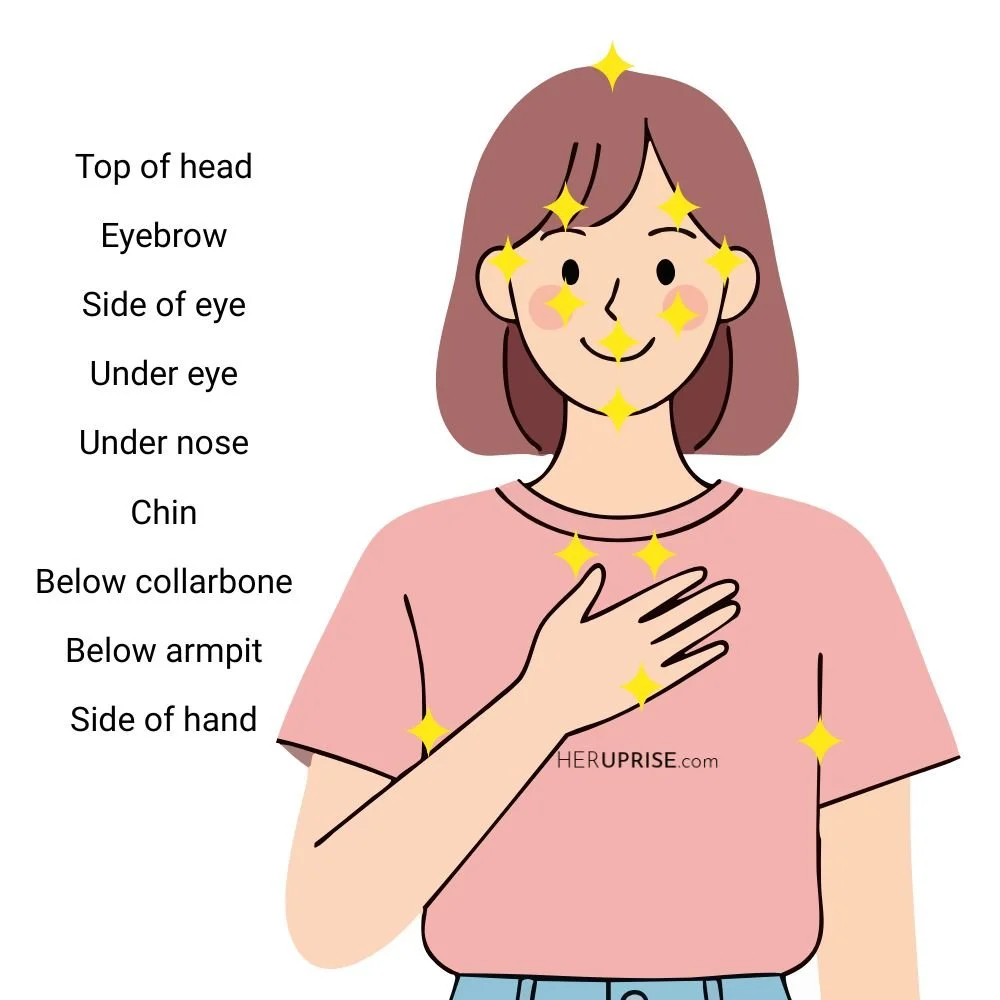
Use your fingers to tap at least seven times (it doesn’t have to be exact — I do it about 12 times) on nine different acupressure points (energy meridians) in your body, while continuously speaking out loud about the negative emotion.
These points are located on your hand, head, face, and chest. (See EFT Tapping points image below).
Continue to speak your truth while moving through the acupressure points over and over until you begin to feel relief from the negative emotion.
Transition to “but what if…” statements to open up to more positive possibilities. (For example, “but what if I could choose to see this differently?”)
Transition to positive statements to anchor that new belief into your mind.
When you feel it’s time (you’ve felt some emotional movement), stop tapping and rate the intensity of the issue again. This will allow you to measure the effectiveness of the exercise.
How to Get Started
If you’re a visual learner, it can help to watch an instructional video to help you locate the acupressure points and understand the flow of tapping and speaking. The one above is by Jess Ortner, a leader in the tapping space. You can find one by me in the self-care for mom’s section of The Motherhood Uprise Course.
Once you’ve memorized the points and understand the technique, it’s more impactful to use your own dialog and make statements specific to your unique situation.
EFT is a gentle therapy and is an amazing tool for releasing emotion with greater ease.
But if overwhelming emotion or trauma surfaces, work a psychotherapist trained to help you.
And like any healing modality, the only way to learn if it’s for you is to try it out.
You never know, those fifteen minutes of tapping could create an incredible shift physically, mentally, and energetically.

If this resonated, here’s a pin for later.

Through Integrative Human Design, subconscious repatterning, and somatic expansion, Keri-Lee Larmand guides visionary women to expand into who they came here to be. Her work supports the quiet unraveling of conditioning so women can return to their natural rhythm, intuitive wisdom, and magnetism.